How to Choose a TFT LCD for POS Terminals
Choosing a display for a POS terminal comes down to four decisions: size, brightness, interface and long-term supply. We walk through each with panels we've supplied to POS customers, 3.5" to 21.5".
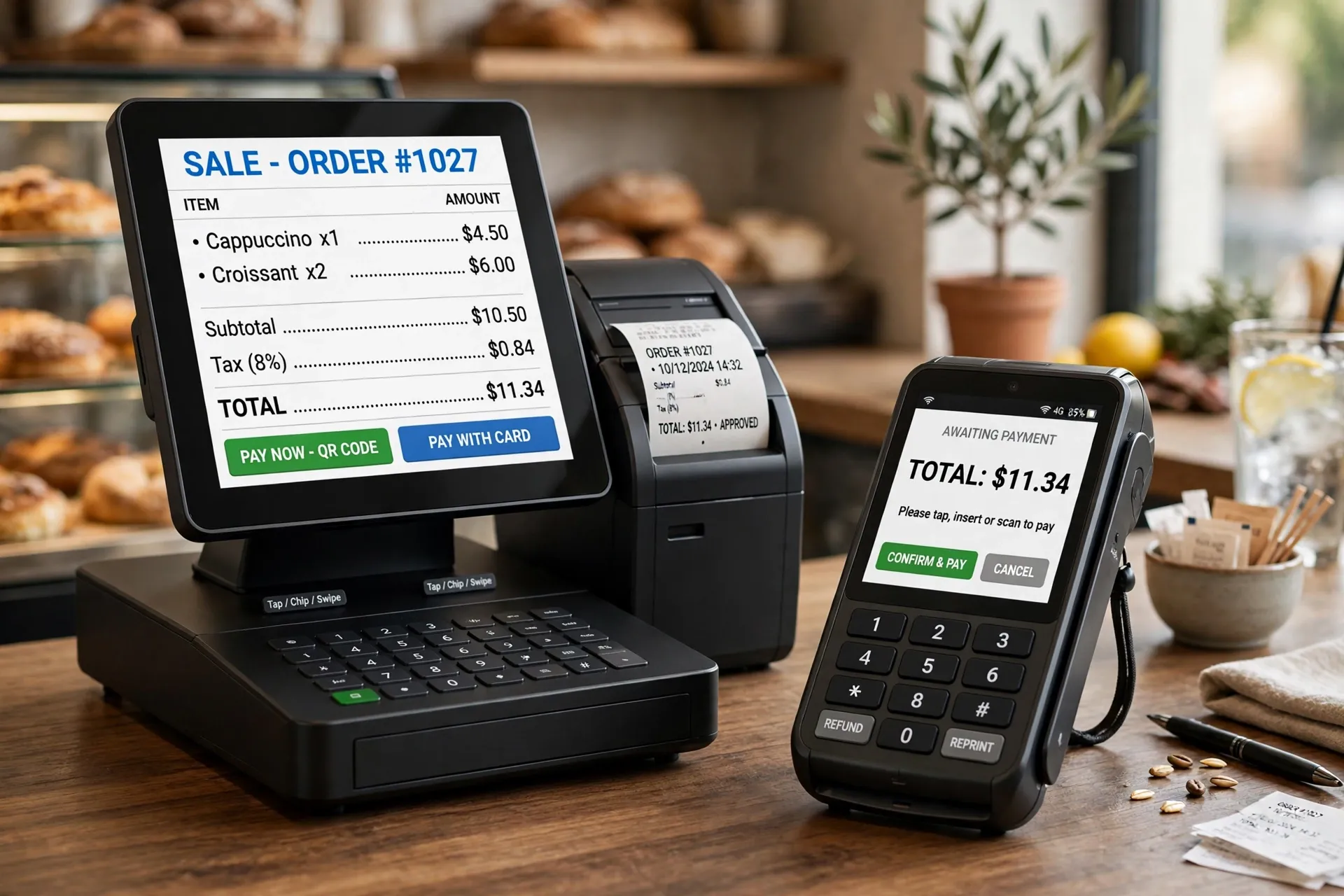
We supply LCD panels for POS cash registers and handheld POS terminals — customers in China and overseas, from 3.5" to 21.5", including customized MIPI and EDP TFT LCD modules for POS terminals built around your machine. We get asked the same thing a lot: which panel fits my machine?
Honestly, it comes down to four things, and the order matters. Get the size right first, then brightness, then the interface — and make sure the panel will still be there when you come back for the next order.
1. Size — start with the machine
Forget the catalogue for a minute and look at the machine. A handheld terminal lives in one hand all day, so it takes a small screen — 3.5", 5.5", 7" or 8". A countertop register has room, so it can take 10.1", 15.6", 18.5" or 21.5".
We've supplied all of these sizes to POS customers. The small ones — our 5.5" YH055WXIM25-01, 7" YH070WSIBM25-01 and 8" YH080WXIM31-03 — are MIPI TFT LCD modules for handheld POS terminals, and that's where most of them end up. The bigger ones mostly go into countertop registers — 10.1" YH101WUBM40-03-1, 18.5" DV185WHM-NM2 and 21.5" DV215FHM-NN0, plus our 15.6 inch LCD screens for POS, the GV156FHM-N43.
If you're looking for an LCD panel replacement for a POS terminal, the size is already decided for you — just send us the part number and we'll check what matches.
2. Brightness — it depends where the machine sits
How many nits does a POS display need? A register on a shop counter, away from the window, does fine at 300 nits. Our 15.6" GV156FHM-N43 runs at 300 nits, and that's where most of them end up.
Put the same machine by a glass door, or use the terminal outdoors, and a standard panel washes out in sunlight. That's when you need a high brightness LCD for outdoor POS terminals — we can build up to 1500 nits for outdoor use.
Our advice is simple: don't pay for brightness you don't need, and don't try to save money on brightness you do need. Tell us where the machine will stand and we'll tell you straight what it takes.
3. Interface — check it before you fall in love with a panel
This is the one people forget until it's too late. eDP vs LVDS vs MIPI for POS terminals — settle that first, because a panel that doesn't match the mainboard means a redesign.
Handheld terminals usually run on MIPI. Our 5.5" YH055WXIM25-01 uses a 25-pin MIPI interface, and the 7" YH070WSIBM25-01 is MIPI as well. Modern countertop boards often use eDP — our 15.6" panel, GV156FHM-N43, runs on 30-pin eDP. Older designs may still use LVDS.
Not sure what your board uses? Send us the board model, or a photo of the connector. We've matched plenty of panels that way.
4. Supply — make sure it's still there next year
A POS machine sells for years, not months. The panel has to be there for the second order and more future orders, not just the first.
That's why we build on original BOE panels for POS terminals where we can, and we keep the same models available for repeat orders. And if a standard panel doesn't fit your machine, we build a custom module around it — panel, backlight and module from one team, so you only have to explain the project once.
Send us your specs
If you already know what you need, send us the size, the quantity, the brightness and the interface — or just the part number of the panel you're replacing. Our MOQ is one carton, samples are available at the regular product price, and lead time is one week for BOE models and two weeks for customized production.
Not sure yet? Tell us what the machine is and where it will be used. We'll suggest a panel and a price — no obligation.