90% of LCD Modules Come from China — What That Means When You're Buying
Most LCD modules now come from China — Samsung's exit made it official. Here's what that means for buyers, and what to check before you order.
The short answer
If you're buying LCD modules today, here's the honest truth: they almost certainly come from China. Not sometimes, not mostly — over 90% of the world's LCD panel supply, by Samsung's own math.
We hear the question a lot, usually phrased politely: "Where do your panels actually come from?" Buyers want to know if they're getting a Korean panel, a Taiwanese panel, or a Chinese panel, as if the country on the box settles the quality question. It doesn't — not anymore. The supply chain already made that decision years ago. What matters now is a different set of questions: is the panel original or assembled, who builds the module around it, and who picks up the phone when something goes wrong.
This isn't our opinion. It's what happened when the biggest name in the business walked away from LCD.
What happened: Samsung walked away
Samsung Display wound up its LCD business and shifted its TV strategy to quantum dot (QD) displays — and Samsung Electronics was left relying on China for much of its future supply of LCD panels.
The numbers behind the story were hard to argue with. Industry experts predicted Samsung would depend on China for more than 90 percent of its LCD panel supply once Samsung Display pulled out of the LCD module market. In the first quarter of 2022, Samsung paid 2.48 trillion won to China's TCL, AU Optronics and BOE for LCD panels — up from 1.86 trillion won in the same quarter a year earlier. LCD panel procurement had risen to 16.1% of Samsung's sales, from 14.3%.
Samsung hadn't planned it this way, exactly. The company originally meant to end its LCD business by the end of 2020, but Samsung Electronics asked it to keep going, worried that its bargaining power would shrink as Chinese suppliers grew stronger. In the end the extension only delayed the inevitable. Samsung also talked with LG Display about securing OLED panels, but those negotiations stalled over price. And its next-generation bet, QD-OLED TVs, had reached consumers in North America and Europe but still had a long way to go before launching in Korea.
So the world's biggest TV maker ended up in a position every buyer can recognize: dependent on a small group of suppliers, paying more for panels than the year before, and without a quick alternative.
How China got to 90%
This didn't happen overnight. Since 2010, China's display industry built large-scale production capacity, and panel supply prices fell sharply. In 2020, Samsung Display sold its LCD factory in Suzhou, China, to TCL China Star Optoelectronics Technology (CSOT), and its domestic plants in South Korea kept cutting production. Year by year, the capacity moved, the know-how moved, and the volume followed.
We watched it happen from inside the industry. Ten years ago, a buyer asking for a panel had real choices about where it was made. Today the choice is mostly about which Chinese maker, and which supplier you trust to deliver the genuine article. BOE, CSOT, AU Optronics — these are the names that now sit behind most of the LCD modules in the world, including the ones inside brands that still sound Korean or Japanese on the box.
That is the part buyers sometimes miss. A TV or a monitor or an industrial display can carry a famous brand while the panel inside was made in China. The brand is the seller. The panel is the supply chain. When you're buying modules rather than finished TVs, you're buying the supply chain directly — so you should look at it directly.
What it means for you as a buyer
First, stop spending energy on the "China or not" question. That question is settled. Spend it on the questions that still change the outcome:
Is the panel original, or assembled? An original BOE panel and an assembled copy can look the same in a photo and behave very differently after six months in the field. We've written a separate guide on how to tell them apart — the label, the packaging, the small details that give a copy away. Read it before you place a big order: How to Tell an Original BOE Panel from an Assembled One.
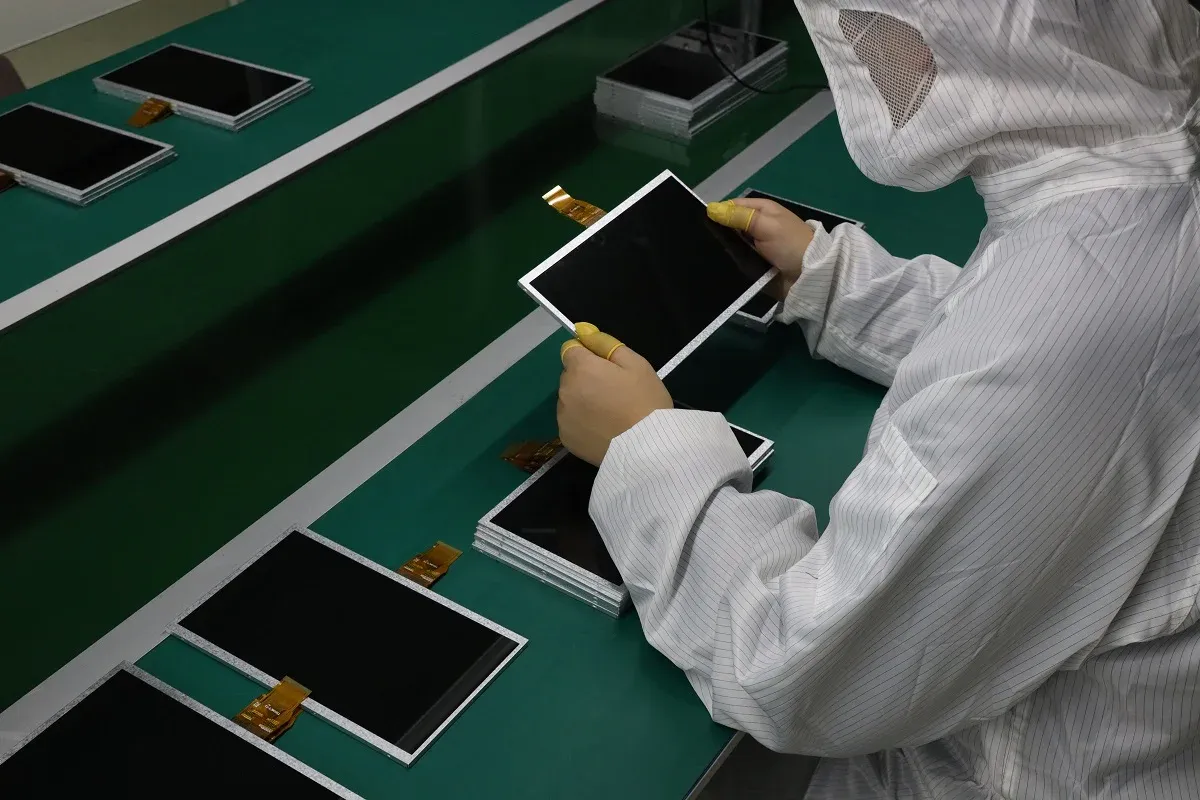
Who builds the module around the panel? A panel is not a product. Someone has to turn it into a module that fits your device — the right interface, the right brightness, the right shape, the right backlight. That work is where most projects succeed or fail, and it's the work a pure trader can't do for you.
What happens when prices move? Falling panel prices helped buyers for a while, but the same forecasts that put China at 90% also warned that Chinese makers were increasing production even as demand fell — and would likely raise supply prices again, squeezing TV makers. Samsung tried to protect its margins with high-end QLED and Neo QLED products, and still found itself squeezed on panel costs. The lesson for module buyers is the same: the cheapest quote today is not a promise about tomorrow. A supplier relationship is worth more than a one-time price.
Does the size and brightness actually fit your application? This sounds obvious, but we see it constantly — a buyer picks a panel by price, then discovers the brightness is wrong for outdoor use, or the interface doesn't match their board. We put together a practical guide on matching size and brightness to the application: How to Choose the Right TFT LCD Size and Brightness for Your Application.
How we work with this reality
We don't pretend the supply chain is something it isn't. The panels come from China — ours included. The difference is what happens after the panel leaves the factory.
We don't ask for big-company quantities. The very large companies want a huge MOQ before they'll even talk to you. We don't work that way. If you need a flexible quantity and a module built to your project, we'll work with you — small and medium orders get the same attention as large ones.
We build on original BOE cell. The heart of our modules is original BOE cell, not an assembled copy. That's the part you can't compromise on, because everything else — the backlight, the interface, the assembly — is built on top of it. If you want to know how to spot the difference yourself, we wrote a guide for that: How to Tell an Original BOE Panel from an Assembled One.
We customize the backlight to your requirements. Brightness isn't one-size-fits-all. A screen for a sunny kiosk and a screen for a hospital ward need very different backlights, so we build the backlight to what your application actually needs — including custom high brightness where the standard panel isn't enough.
And our VIP service saves you communication costs. You tell us what you're building once, and one team handles the panel, the backlight and the module together. No repeating your project to three different departments, no chasing answers across suppliers.
If a model isn't a good fit for you, we'll tell you that too. We'd rather lose one order than ship a panel that comes back.
If you're sourcing LCD modules now, send us the size, interface and brightness you need, and what the screen is going into. Our RFQ guide explains what to prepare so we can quote you properly: Request a Quote for TFT LCD Modules. Or write to us directly at lisa@gd-ytgd.com — tell us what you're building, and we'll tell you honestly what we can do.